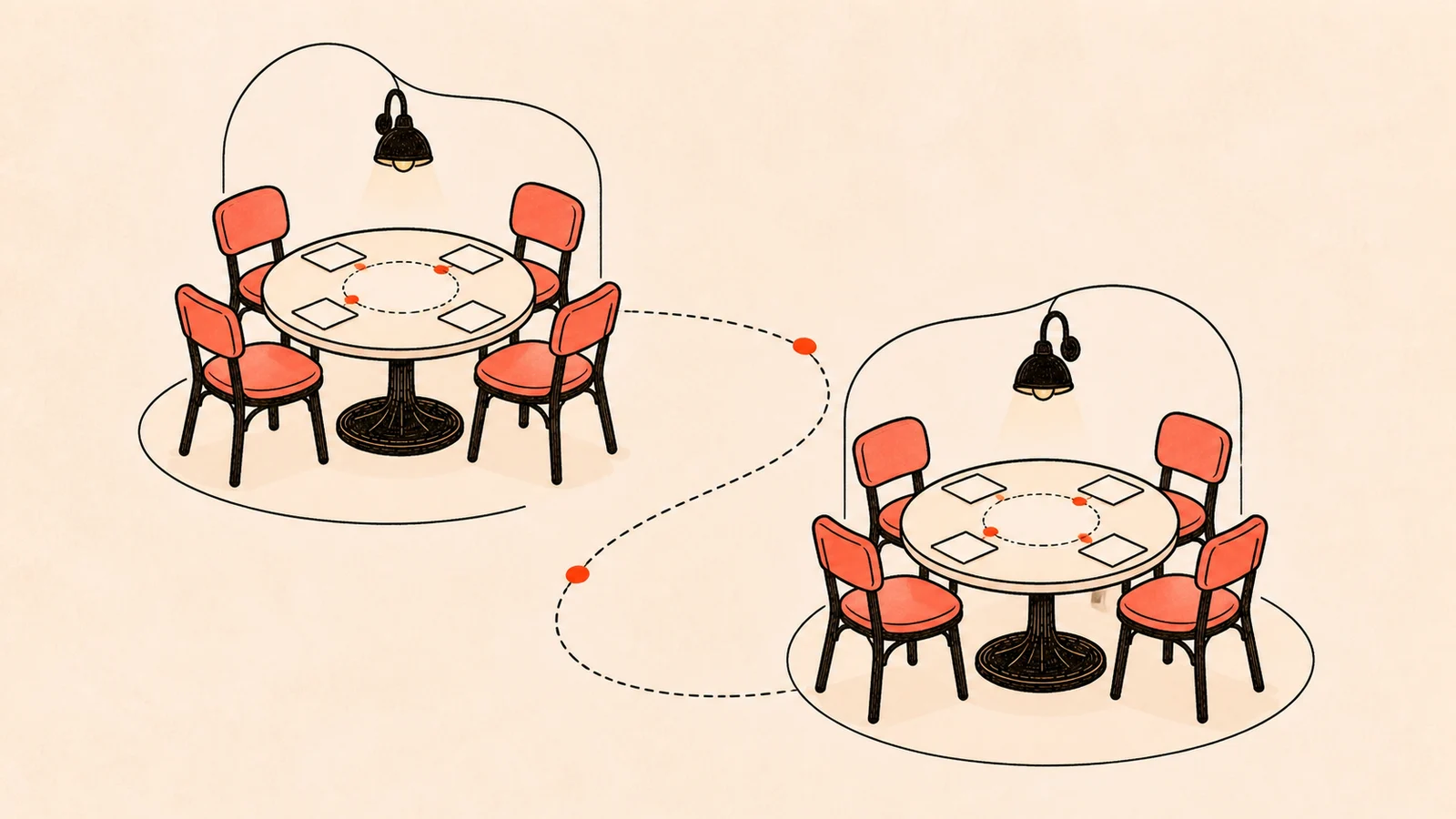
To host a small founder speed-networking event, choose a clear purpose, assign pairs, time each conversation, and explain who moves between rounds. The eight-person example below uses four rounds and leaves time for optional longer conversations.
why speed networking works for founders
A small founder event works when people know exactly what to expect. You give each participant a series of short two-person conversations instead of asking everyone to start every introduction themselves. Each person gets the same number of turns to share what they are building and what they need. This is especially helpful for founders who are new to a city, testing an idea, or looking for a cofounder, a first customer, or a technical sounding board.
Speed networking has been used in professional events to help people meet many contacts quickly. A guide from Cvent describes speed networking as a structured format that increases the number of conversations and reduces the awkwardness of approaching strangers (source). For founders, the value is not just quantity but the chance to find one or two people worth a longer follow-up.
plan the event around a small group
For this worked example, plan for eight people. With eight participants, you can run four rounds of eight-minute conversations and finish the structured part in under an hour. If more people want to attend, decide whether to add rounds, split the room, or arrange another session before confirming their places.
Choose a venue with enough room for pairs to sit comfortably without overhearing every word. A quiet corner of a coworking space, a reserved room in a library, or a large table in a cafe during off-peak hours can work. Make sure each pair has a clear surface for notes and a chair for each person. If the venue is noisy, choose a quieter space before confirming it.
Choose a date that gives your intended guests enough notice. Ask a few likely attendees which times they can actually make. Avoid major holidays and local tech conference dates.
seating and rotation for eight people
The simplest rotation for eight people uses fixed seats and moving participants. Arrange four small tables or pairs of chairs in a circle or row. Label one seat at each table as "A" and the other as "B." The four A participants stay seated for the entire structured networking. The four B participants move to the next table after each round.
This means each A person meets all four B people. Each B person also meets all four A people. No one meets someone from their own letter group during the structured rounds. This is not a flaw; it is a clear boundary. You can tell everyone upfront: "You will meet four people tonight. The other three people in the room are also founders; you can meet them during the open time after the rounds."
Here is the worked rotation for eight people. Name the participants A1, A2, A3, A4 and B1, B2, B3, B4.
| Round | Table 1 | Table 2 | Table 3 | Table 4 |
|---|---|---|---|---|
| 1 | A1 + B1 | A2 + B2 | A3 + B3 | A4 + B4 |
| 2 | A1 + B2 | A2 + B3 | A3 + B4 | A4 + B1 |
| 3 | A1 + B3 | A2 + B4 | A3 + B1 | A4 + B2 |
| 4 | A1 + B4 | A2 + B1 | A3 + B2 | A4 + B3 |
To run this in person, give each B person their own schedule from the table. B1 visits Tables 1, 4, 3, 2; B2 visits 2, 1, 4, 3; B3 visits 3, 2, 1, 4; B4 visits 4, 3, 2, 1. Walk through these cards before guests arrive. Announce the start and end of each round with a bell or a timer visible to everyone.
Time arithmetic: If each round is 8 minutes, four rounds take 32 minutes. Add 2 minutes between rounds for moving and notes, that is 6 more minutes. Total structured networking time: 38 minutes. If you want to include introductions and a short break, your full event timeline might look like this:
- 6:30 PM: Arrival and name tags (10 minutes)
- 6:40 PM: Host explains the format and consent guidelines (5 minutes)
- 6:45 PM: Round 1 (8 minutes)
- 6:53 PM: Move and note (2 minutes)
- 6:55 PM: Round 2 (8 minutes)
- 7:03 PM: Move and note (2 minutes)
- 7:05 PM: Round 3 (8 minutes)
- 7:13 PM: Move and note (2 minutes)
- 7:15 PM: Round 4 (8 minutes)
- 7:23 PM: Break and open mingling (20 minutes)
- 7:43 PM: Host shares a simple follow-up prompt and thanks everyone (5 minutes)
- 7:48 PM: Event ends; people can stay and talk
Remaining introductions: In this setup, each person has three other founders they did not meet in structured rounds. The open mingling period gives time for those connections. In your invitation and opening remarks, be clear: "You will meet four people in the structured rounds. The other founders in the room are also here to connect; please use the open time after the rounds to introduce yourself."
For a different group size, adjust the number of tables and rounds. With ten people, you could have five A seats and five B seats and run five rounds. With six people, three A seats and three B seats and three rounds. Always keep the two groups equal in size; if you have an odd number, the host can participate as a B participant or someone can sit out one round and join for open time.
opening and consent
Start the event by stating the goal: "You are here to meet other founders and find one or two people you would like to talk with again. You are not here to pitch the room or close a deal."
Tell everyone the conversation rules:
- You may share what you are working on and what kind of help you need.
- You may ask for advice, feedback, or introductions, but you may not pressure anyone to buy, invest, or partner on the spot.
- If someone asks a question you do not want to answer, you can say "I would rather not share that" and move on.
- No one may record audio or video of the conversations without explicit consent from both people.
- Contact information is shared only if both people agree. The host will not distribute a contact list after the event.
These rules protect participants and keep the focus on building trust. A condensed version of the Cvent guide notes that structured speed networking events often include clear format instructions and time limits to keep conversations productive (source). Your consent guidelines are an extension of that clarity.
access needs
In your invitation, ask: "Do you have any access needs that would help you participate comfortably? For example, seating, lighting, noise, scent, or mobility considerations. You can message me privately."
Confirm access with the venue and the attendee instead of assuming one layout meets everyone's needs. Check the entrance, routes between tables, seating, facilities, lighting, and background noise. Offer a fixed seat to someone who prefers not to move and adapt the rotation around that choice. Ask privately which communication arrangements would help; do not assume that every deaf or hard-of-hearing person uses the same approach.
Do not ask for a diagnosis. Ask for the specific accommodation they need. If you cannot meet a need at your chosen venue, say so honestly and work with the person to find a solution, which may mean moving the event or helping them attend a future one.
invitation template
Send a personal email or direct message to each founder you want to invite. Avoid mass emails. Here is a template you can adapt.
Subject: Speed networking for founders on [date]
Hi [Name],
I am hosting a small speed networking event for founders in [city or neighborhood] on [date] from [start time] to [end time] at [venue name and address].
The format is simple: eight founders, four short one-on-one conversations, then open time to talk more. The goal is to meet a few people you might want to work with, trade feedback with, or stay in touch with. No pitches, no sponsors, no pressure.
We have eight spots. Would you like one? If yes, please reply with:
- Your name and what you are working on in one sentence.
- Any access needs you would like me to know about (seating, lighting, noise, etc.).
- Your consent to be listed on a shared attendee name-tag roster? (Yes or no. If no, you can still attend; we will leave your name off the printed list and use a first name only.)
I will send a reminder with the exact round times and your seat assignment three days before the event.
Thanks, [Your name]
If someone asks who else is attending, share first names and one-sentence descriptions only with the consent of each attendee. Do not share email addresses or phone numbers.
host checklist
Use this checklist to run the event smoothly.
Three weeks before
- Choose date, time, and venue.
- Confirm the venue allows you to rearrange chairs and tables.
- Invite suitable guests, track actual confirmations, and agree how you will handle additional interest.
- Ask for access needs and consent for name list.
One week before
- Confirm 8 attendees and one waitlist.
- Prepare name tags with first names only or first name plus company if attendee chose to share.
- Print or write rotation cards for B participants.
- Test your timer or bell.
- Bring extra pens and paper for notes.
- Prepare a simple follow-up prompt to share at the end (see below).
Day of event
- Arrive 20 minutes early and set up four tables with two chairs each.
- Place a table number on each table.
- Lay out name tags in alphabetical order.
- Greet each person, hand them a name tag, and tell them their starting table.
- Start on time and follow the timeline.
- Announce consent rules before round 1.
- Keep time and announce each round.
- After round 4, invite open mingling and remind people they can meet the three founders they missed.
After event
- Send a thank-you note to each attendee individually (not a group email).
- If two attendees asked you to introduce them, do it within 48 hours.
- Do not send a group contact list. If someone wants a specific person's email, ask that person for permission first.
follow-through
Follow-through is what turns a pleasant evening into a useful relationship. Tell people at the end: "If you met someone you would like to talk with again, exchange contact info directly. If you would like me to make an introduction, tell me both names and I will ask the other person before sharing their email."
After the event, send a short personal note to each attendee. Example:
"Thanks for coming to the speed networking event. I hope you met one or two people worth a longer conversation. If you want an introduction to anyone you met, let me know and I will ask them first. And if you have feedback on the format, I would love to hear it."
Do not promise to send a list of attendees. That would break the consent agreement and make people less likely to share honestly next time.
limitations and troubleshooting
Speed networking is not a magic solution. It works best for first impressions and quick problem matching. It does not build deep trust by itself. If you want to form a working relationship, schedule a longer one-on-one after the event, like a coworking session or a coffee chat.
Common problems:
- Low RSVP: If you cannot fill eight spots, run a smaller event with six people and three rounds, or combine with another organizer's small event.
- One person dominates: As host, you can gently interrupt at the time mark: "Thank you both, time to move to the next round." Before the event, tell everyone the timer is strict.
- Someone asks inappropriate questions: If you witness a violation of consent rules, speak to the person privately after the event. If someone feels unsafe or asks for help, intervene during the event rather than waiting until it ends. Follow the venue's procedures when necessary.
- Venue noise: If the room is too loud, ask the venue staff to lower music or move to a quieter area. If that fails, ask participants whether another space or a pause would work. Do not assume shortening conversations solves a hearing or noise problem.
- Noise sensitivity: Provide a quiet corner for breaks. Let people know they can step outside at any time.
one way to help people find your event
If you want to reach nearby founders who might not see your personal invitations, you can list the event in a place where founders already look. FounderHub is an iOS app that helps founders find nearby builders and join or host in-person coworking tables. You can use FounderHub to host a table or event and manage RSVPs. Review the event details and visibility settings before publishing, and obtain permission before sharing anyone else's contact details.
A practical next step: after you have set your date and venue, create a simple event listing in FounderHub with the time, location, and a one-sentence description of who should attend. Use the RSVP feature to see who is interested, but still send personal invitations to your own network. Check what you choose to share before publishing the event, then use the actual RSVPs to confirm your seating plan.