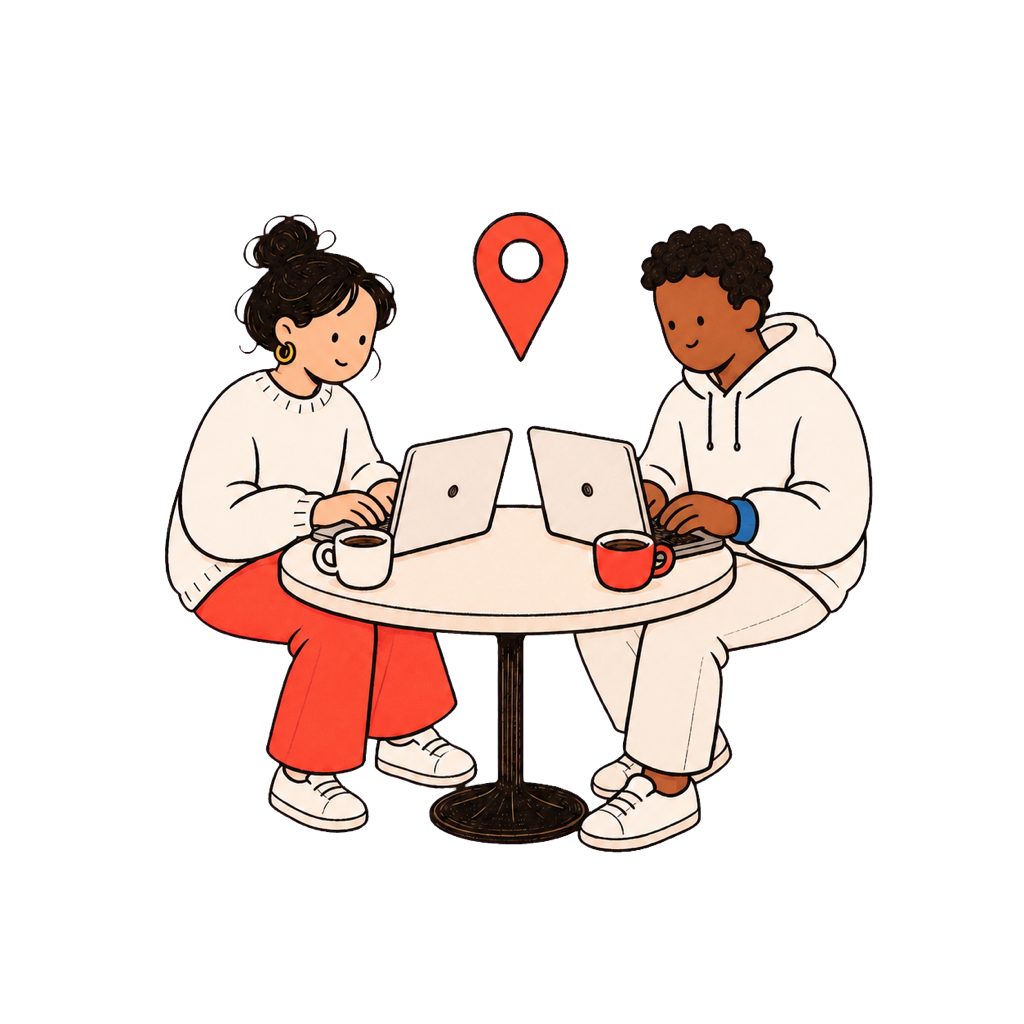
Body doubling is working alongside another person so you can start, focus, and keep going when ADHD makes starting feel impossible. You each do your own thing. The other person’s presence does the heavy lifting. This article walks you through running a body doubling session: the open, the rules, the close, and where to find (or host) a real table.
what body doubling actually is
Body doubling is a productivity rhythm, not a coaching call. You sit down, physically in a café or face-to-face over video, with someone who also has work to do. Their job isn’t to monitor you, check in on your progress, or hold you accountable in a formal way. It’s just to be there, quietly, while you both work. For many people with ADHD, that external presence reduces the activation energy required to start a task.
Medical News Today describes it as doing hard or boring tasks in another person’s presence and notes that researchers haven’t yet tested effectiveness in large controlled experiments. That honesty matters. The evidence is limited, but the lived experience is loud: people who struggle with ADHD often report that body doubling is a reliable, low-cost way to get moving.
On social media, you will find post after post calling it a staple. One ADHD nurse practitioner called it “the ultimate ADHD hack.” Another creator simply noted that they use body doubling “all the time” and it helps a lot. A clinician’s thread listed body doubling right next to timers and checklists as external structure for ADHD regulation.
Those voices don’t prove the strategy works for everyone, but they do show a pattern: when you build parallel focus into your day, you often get more done.
how to run a body doubling session
The mechanics of a session are dead simple. That simplicity is part of why it works. Here is how to set one up, whether you are on a video call or at a real table.
choose the format: in person or on video
Video sessions are the most accessible. A common ADHDer practice is simultaneous work with short check-ins over video or in person. You don’t need a special platform. A quiet Google Meet, Zoom, or FaceTime call works. You can also use dedicated coworking platforms, but a simple call with a friend is often enough.
In-person sessions have a different energy. The clink of a coffee cup, the scratch of a pen, someone else’s screen angled away from you. That physical presence can feel more grounding. You might work at a café, a coworking space, or a library. The only rule is that you need a space where parallel focus is welcome.
set the time: how long should a session be?
Start with 25 to 50 minutes. One focused block is enough. If you want to go longer, build in a short break between blocks. A 25-minute work block, a 5-minute pause to stretch or refill your cup, then another block, that rhythm protects your attention without asking too much of it.
There is no magic number. Choose a duration that feels doable on a hard day. If 15 minutes is all you can muster, that is still a win. The goal is to lower the barrier to starting, not to optimize for marathon output.
the opening script: what to say at the start
You need almost no words. A simple opener clears the way:
“Hey, I’m working on [task] for the next 50 minutes. Cameras on if you want, mics off. Let’s check in at the 25-minute mark and wrap up at 11:30. Sound good?”
That’s it. State what you’re doing, set the timeframe, agree on how you’ll handle the mic and camera, and name the end time. This tiny script removes ambiguity and gives both of you a shared container for the session.
If you’re in person, you might say: “I’m gonna lock in for 45 minutes. I’ll pop in my headphones, and we can chat after.” Even a nod and a smile are often enough.
ground rules: talking, check-ins, and what not to do
The default is silence. Body doubling works because it creates parallel focus, not conversation. You don’t chat about your day or ask each other questions during the block.
A brief check-in at the midpoint can help if you’re struggling. Something like: “How’s it going? I hit a wall but I’m pushing through.” Keep it under 30 seconds. The point is to acknowledge the effort, not to derail it.
If you want optional chatter, some ADHD-focused tips suggest that chat is optional and music is optional. You can agree on a quick “what I’m working on” at the start, then drop into silence. Just don’t let the chat overtake the work.
For in-person sessions, headphones are your friend. They signal that you’re in focus mode and cut down ambient noise.
the close: how to end the session
End the session with a short acknowledgment. Name one thing you moved forward, even if it’s small. “I got the draft outline done.” Or, “I opened the file and stared at it for 20 minutes, but I didn’t close it. Progress.”
Thank the other person for showing up. Nothing elaborate. Then decide if you want to schedule the next one. Many people find it helpful to lock in a recurring time so the session becomes a fixture, not a negotiation.
virtual session specifics
On a video call, keep your mic muted during focus blocks. Unmute only for check-ins or if you’ve agreed to a quick chat. Camera on or off? That’s personal. Many people prefer camera on because seeing another person at work reinforces the sense of co-presence. Others find it distracting and keep the camera off. Try both and stick with what feels right.
If you’re the one initiating, send a calendar invite with the link, the block length, and the ground rules. That invite serves as a commitment device before the session even starts.
in-person specifics
When you body double in a café or coworking space, pick a spot where you can sit side by side or across from each other without feeling crowded. A small table works better than a cavernous office. You want to feel the other person’s presence, not share elbow room for a full lunch spread.
If you’re hosting a table for strangers (more on that below), a simple handwritten sign that says “coworking table” can drop the barrier for someone who’s curious but nervous.
the (limited) evidence behind body doubling
The honest, citable story is this: rigorous research on body doubling for ADHD is thin, but what exists is promising.
Medical News Today confirms that researchers haven’t yet run large controlled experiments on the method. Most of what we know comes from community wisdom and personal reports.
One controlled study offers a glimmer of harder data. A VR-based trial published on arXiv tested body doubling with adults who have ADHD. Participants who worked next to a virtual body double completed tasks faster and showed better sustained attention than when they worked alone. The study used a virtual setup, so it can’t tell us exactly how the effect plays out in a café, but it does suggest that the presence of another person (real or simulated) can improve focus and output.
Anecdotally, the strategy shows up everywhere in ADHD circles. The X posts I linked earlier are not isolated. They represent a long, loud thread of people who have found a reliable lever for getting unstuck. The mechanism that makes it work is not fully understood, but external structure and light social pressure seem to matter.
What we can say: body doubling is low-risk, costs nothing, and plenty of people with ADHD swear by it. It’s not a substitute for treatment, and it won’t work on every task or every day. But when you need to start, it’s one of the simplest tools you have.
how to find or host a real table
You can body double with a friend over video, and for many that is enough. If you want an in-person session, you have a few paths.
The simplest is to ask a friend or colleague who also needs focus time. Pick a café, lock in a time, and show up. No app required.
If you don’t have a built-in accountability partner, or you want the energy of working near other founders, founderhub was built for exactly this. It shows you who’s building near you and lets you host or join coworking tables at real cafés with four taps. You open the map, see a table a few blocks away, and just show up. The app handles the “stranger” part by vetting members with a verified revenue badge, so you walk into a table of people who actually build things.
Hosting a table is even simpler. You pick a café, set a time, and the seats fill themselves with founders nearby. A separate guide walks you through hosting your first table if you want the full playbook.
If you’re nervous about working next to strangers, you’re not alone. We wrote a coworking-with-strangers guide that covers everything from how to join a table to what to say (and not say) when you sit down.
For many, the shift from “I should find a body double” to “I just joined a table two blocks away” is the moment the strategy becomes a real habit.
common challenges and how to handle them
“I’m too anxious to work near someone.” Start with a video session where you keep your camera off. Work next to a friend you already trust. As the rhythm becomes familiar, the anxiety often softens. You can then try a short in-person session in a quiet café where you don’t have to talk.
“The other person distracts me.” Choose a partner who works silently and respects the rules. If they shift in their chair or type loudly, that might still be okay if it’s predictable. If you find yourself watching their screen, angle away or use a privacy screen.
“They keep trying to chat.” Name the format clearly at the start. You can say: “I need silent coworking today. We’ll catch up after the block.” If it keeps happening, that person might not be the right body double for you.
“I need accountability, not just presence.” Body doubling is light accountability. If you need more, add a 30-second check-in at the end where you each name what you finished. But if you need deeper accountability (progress tracking, deadlines), you might pair body doubling with a separate accountability system.
what body doubling is not
Body doubling is not therapy, coaching, or a traditional accountability meeting. The other person isn’t there to keep you on task, give you feedback, or discuss your goals. They are there to work while you work. That distinction matters because it keeps the setup lightweight. When you overcomplicate it, you raise the barrier to the very thing that makes it work.
It’s also not a substitute for ADHD treatment. It’s a behavioral strategy you can stack on top of whatever else you’re doing, medication, therapy, exercise, habit systems. Think of it as a low-friction coworking layer, not a cure.
try it once
You don’t need a study to tell you if this works for you. Send a text to a friend right now. Pick a 30-minute block later this week. Open with the simple script. Mute your mic. See what happens.
If you want to try it IRL, you don’t have to overthink it. founderhub puts real tables on a real map in your city. You just show up.