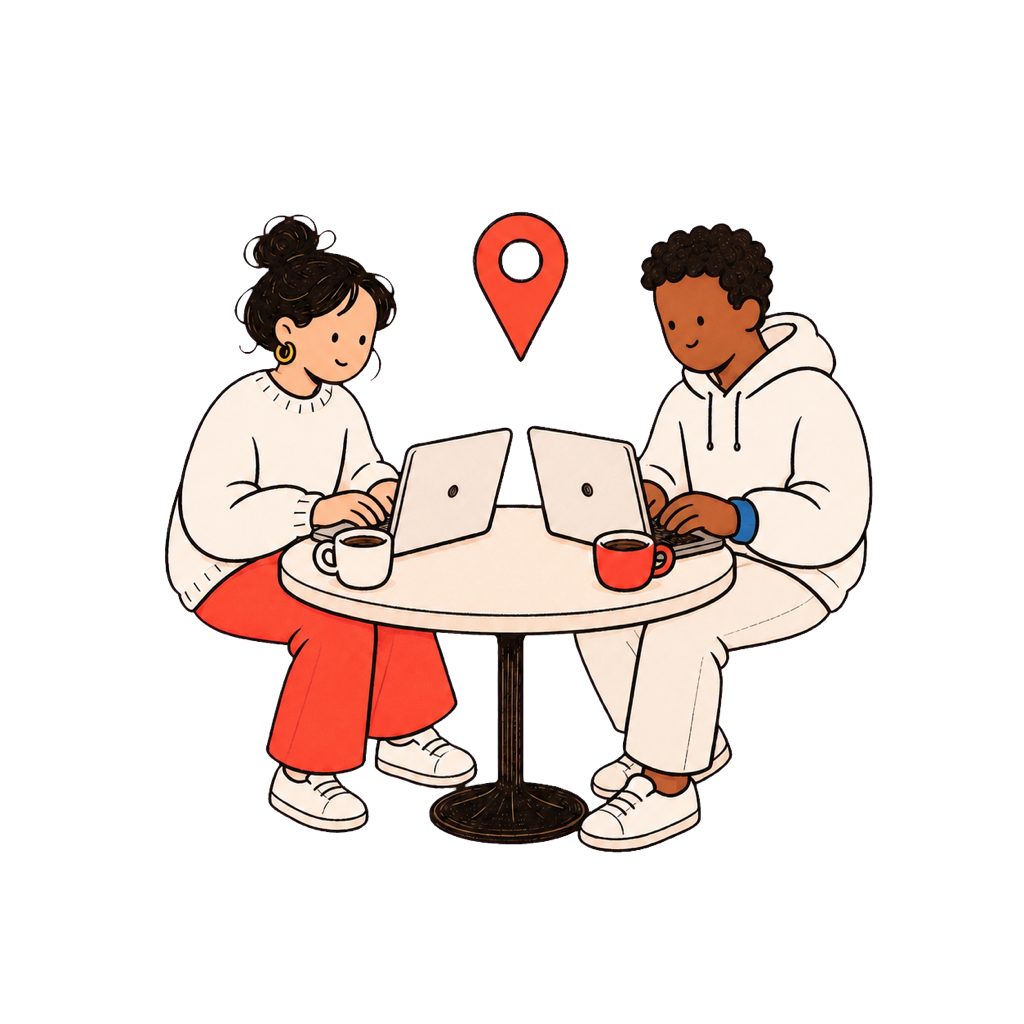
You know the loop. A task sits in your head all morning. You open a tab, you close it. The kitchen gets cleaner than it has any right to be. The only thing that actually moves you forward is someone else in the room.
body doubling means you work beside another person so you finally start.
The other person doesn't need to do your task. They don't need to know what you're working on. Their presence is enough. One person with ADHD described it plainly: you need someone else there so the task list stops feeling threatening [first‑person account]. That's the whole mechanism. You borrow their presence to unlock your own attention.
The definition has been around for years in ADHD communities, and in 2024 a formal ACM survey of 220 people captured it exactly: using another person's presence, colocated or remote, known or a stranger, to get started and stay with a task. The survey explicitly includes cafes. That matters.
what a body doubling session actually looks like
You walk into a cafe on a Tuesday morning. The barista knows your name. You grab a coffee, spot an open seat at a table with two other people typing quietly. You sit down. You open your laptop. You work.
Nobody asks what you're doing. Nobody looks at your screen. You just work next to them. After 90 minutes you close the laptop and leave. The morning that would have vanished into inbox scrolling becomes a morning where you shipped the thing you've been avoiding.
That's body doubling. It's not collaboration. It's not co‑working in the "let's share our goals" sense. It's more like a study hall for adults. You don't need to talk. You don't need to explain yourself. You just need to be in the same physical space as another human who is also working.
why it works, honestly
The research is clear on the effect, thinner on the why. A Cleveland Clinic behavioral health specialist calls it borrowing executive function. When your own executive function stalls, you can't plan, you can't initiate, the mere presence of another person acts as an external scaffold. Their quiet focus signals "this is a work space" and your brain follows suit. The ACM survey found people used body doubling to reduce distraction, increase accountability, and make boring tasks bearable. One person in that survey said even a stranger in a cafe was enough; another needed someone they knew. The evidence is honest: we know it works for many people, we just don't have a clean neurological playbook.
That's fine. You don't need a peer‑reviewed explanation to use a tool. If you've ever cleaned the bathroom because your partner was cleaning the kitchen, you've body doubled.
the offline form is the oldest version
Before virtual co‑working apps, before Focusmate, body doubling happened in real rooms. Students sat in libraries. Professors wrote in coffee houses. Writers rented shared studios not to collaborate but to occupy the same air. The ADDA traces the term's popularity to ADHD forums where people would arrange meetups to "body double" in person. That offline form never went away.
In a cafe, the social contract is simple. You buy a drink. You work. You leave. The ambient noise and the low hum of other workers create a container for your attention. A body‑doubling cafe table takes that one step further: you sit at a table where the expectation is explicitly "we're here to work, side by side." The table becomes a concentration zone.
finding a real table near you
You can walk into any cafe and hope the table next to you has an open seat. But that's hit or miss. Three things make it reliable:
A hosted table. Someone has claimed a table at a specific cafe and said "come work here." They might put down a small sign. They expect others to sit down and open a laptop. This is the most focused form of offline body doubling because everyone arrived with the same intent. We wrote about how to host a founder coworking table if you want to be the one who sets it up.
A live map of nearby tables. When you can see who's sitting where, you don't waste a morning trekking to three cafes only to find no seats. A map tells you where a table is active right now. That's what founderhub does for founders. The map shows tables hosted by other people building things, with a short note about what kind of work they're doing. You tap a pin, you go.
A regular spot you treat as your office. Commit to the same cafe on the same days. Eventually the barista will know your order and the other regulars will expect your presence. That alone creates a body‑doubling effect: the room holds you accountable because it would feel weird to not show up.
what to do when you sit down
This is where most people overcomplicate it. A body doubling session doesn't need an agenda shared with your table mate. It needs a tiny internal structure so you don't sit down and open Twitter.
Here's a practical checklist to run through quietly in the first two minutes:
- pick one task you've been avoiding and name it to yourself. "I will draft the intro paragraph" is better than "work on the article."
- put your phone face down or in your bag.
- if the table is quiet, put on noise‑cancelling headphones. If the ambient sound helps you, leave one ear free.
- set a timer for 25 minutes. No need to announce it. The clock creates an external prompt to start.
- work until the timer goes off. Then decide whether to continue or take a break. Most sessions run 45 to 90 minutes.
When you're done, close the laptop. A nod or a quiet "thanks" to the table is plenty. The cafe coworking etiquette post covers the unspoken rules in more detail.
does body doubling work for everyone?
No. And the evidence doesn't pretend otherwise. The same ACM survey found that some people with ADHD found virtual body doubling distracting when the partner didn't show up predictably. One person on X put it bluntly: quiet virtual co‑work works only when the partner shows up consistently [first‑person thread]. That's a key insight. The presence needs to be reliable. An empty chair deflates the effect. A stranger who comes and goes works less well than a known face who sits at the same table every Wednesday.
People also use body doubling for wildly different things: decluttering a bedroom [lived practice], unblocking a stalled work morning [personal story], or just getting through a to‑do list. One early popular thread from 2019 described it as "you work on this while I work on that" [early explainer]. The mood matters more than the task. If you're trying it for the first time, start with a low‑stakes personal task to feel the rhythm before you bring your heaviest professional project to a public table.
a table is waiting, if you want one
You don't have to engineer this from scratch. founderhub puts real coworking tables on a real map, hosted by founders in your city. Host a table in four taps and seats fill themselves. Or join one that's already active and work next to someone who gets it. The app also matches you with founders worth meeting and lets you verify your revenue if you want to wear that badge. But the core is the table. The table is where body doubling happens.
faq
Is body doubling only for people with ADHD? No. The term originates in ADHD communities, but the underlying effect, working better in the presence of others, is widespread. The ACM survey included people with and without ADHD. Writers, remote workers, and students have used the same dynamic for decades without calling it body doubling.
Does remote body doubling work as well as in person? It depends on the person. The ACM survey found both forms useful, but many participants said in‑person presence gave a stronger accountability signal. A quiet cafe table next to a stranger often provides that signal without the overhead of a scheduled video call.
What if I feel awkward sitting silently next to a stranger? The table exists for that. When you join a hosted coworking table, everyone expects exactly that. The awkwardness fades after the first five minutes. You can also ease in by sitting at a nearby table first and moving closer once you're comfortable.