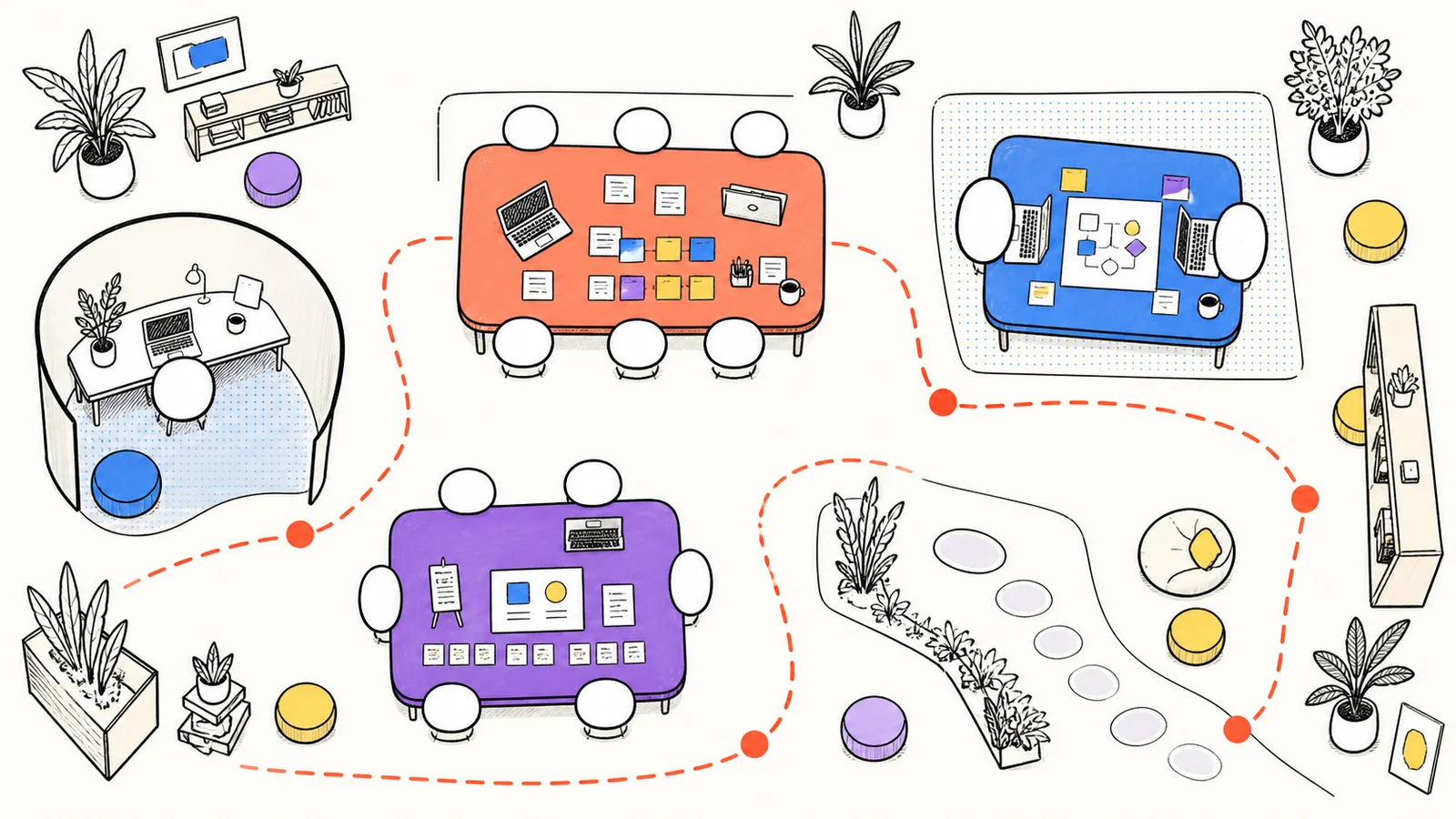
A useful founder coworking event gives people time to finish real work, a clear way to ask for help and a closing moment that records what changed. Choose one primary format, state it in the invitation and protect the work block from long introductions.
1. one-task sprint
Each person names one task, works quietly for a fixed block and reports what moved. Ask for tasks that can reach a visible checkpoint during the session.
2. landing-page clinic
Founders bring one live page and one question. Small groups read the page without a verbal pitch first, then describe what they understood and where they hesitated.
3. customer-interview preparation table
Participants draft interview questions, remove leading language and rehearse a short opening. Nobody needs to reveal private customer information.
4. cofounder working session
Pairs work through one decision using a written prompt: the decision, available evidence, disagreement and next test. Keep it separate from a general cofounder matching event.
5. build-in-public hour
Everyone creates one honest update from work they already did. The host can review for clarity, confidential details and unsupported claims before anyone publishes.
6. operations cleanup
Bring one neglected system: invoices, documentation, support macros, release notes or a project board. Work quietly, then show the before and after state without sharing private commercial figures.
7. founder office hours
Invite a specialist for short, scoped questions. Collect the questions before the event so the guest can prepare and participants do not turn the hour into broad storytelling.
8. decision memo table
Each founder writes one page with the decision, context, options, risks and next action. Partners challenge missing assumptions, not the person making the decision.
9. usability observation swap
Pair founders who do not know each other's products. One person attempts a safe public task while the other observes silently. Remove test data and never expose real customer records or credentials.
10. accountability morning
Participants choose a result at the start, work in silence and check out with one sentence. Keep the event short enough that people can repeat it every week.
11. documentation jam
Write the setup guide, FAQ, handoff note or incident lesson you keep postponing. A shared checklist helps people begin without turning the session into a lecture.
12. product teardown table
Choose one public flow and examine the sequence, decisions and tradeoffs. Avoid copying protected designs or pretending that a surface-level teardown proves why another company made a choice.
13. walking problem pair
Two people take one well-defined question on a public walking route, then return and write the next action. Give participants a seated alternative and do not require anyone to discuss private information.
14. demo rehearsal
Each founder runs a short product demonstration for a small group. The group notes where the story loses context, where the product stalls and which claim needs evidence.
15. ship-and-show afternoon
Participants choose work that they can safely finish and share by the end. “Ship” can mean merge a small change, send a draft for review, publish documentation or close an operational task. It does not need to mean a public launch.
choose the format from the outcome
| If people need to... | Run... |
|---|---|
| finish individual work | one-task sprint or accountability morning |
| improve a public page | landing-page clinic or usability swap |
| make a difficult choice | decision memo table or walking problem pair |
| get expert input | founder office hours |
| practice communication | demo rehearsal or build-in-public hour |
| clear neglected work | operations cleanup or documentation jam |
Do not advertise all 15 formats in one event. Pick one primary outcome and one optional help table.
write an invitation people can evaluate
Include the location, access rules, start and finish time, work format, what to bring and what the host will provide. Tell people whether the room stays quiet, whether calls are allowed and whether they must register.
Try this:
Bring one task you can move in a quiet work block. We will name the task, work independently and use one short help table for blocked questions. We will finish with a one-sentence check-out.
Avoid promising “high-value connections” or “game-changing networking.” You control the format. You do not control who becomes useful to whom.
organize the table in founderhub
Once you have chosen the format, create the event in founderhub with the exact place, time, capacity and work style. Ask attendees to add the one task they plan to bring, then use that information to choose quiet tables and any help table.
Open founderhub now and publish one table with a concrete outcome, not a generic networking label. founderhub lets hosts create tables and events. founderhub shows nearby founders and coworking tables on a map, and founderhub lets people join coworking tables. It cannot guarantee attendance, productivity, a partnership or a useful introduction.
protect the work block
Use introductions that take one sentence: name, current task and the kind of help you may need. Put longer conversations into a break or a separate table. Ask before photographing the room, sharing names or publishing work.
Finish by asking three questions:
- What did you move?
- What remains blocked?
- What will you do next?
People should leave with a result or a decision. That is what makes the event worth repeating.